


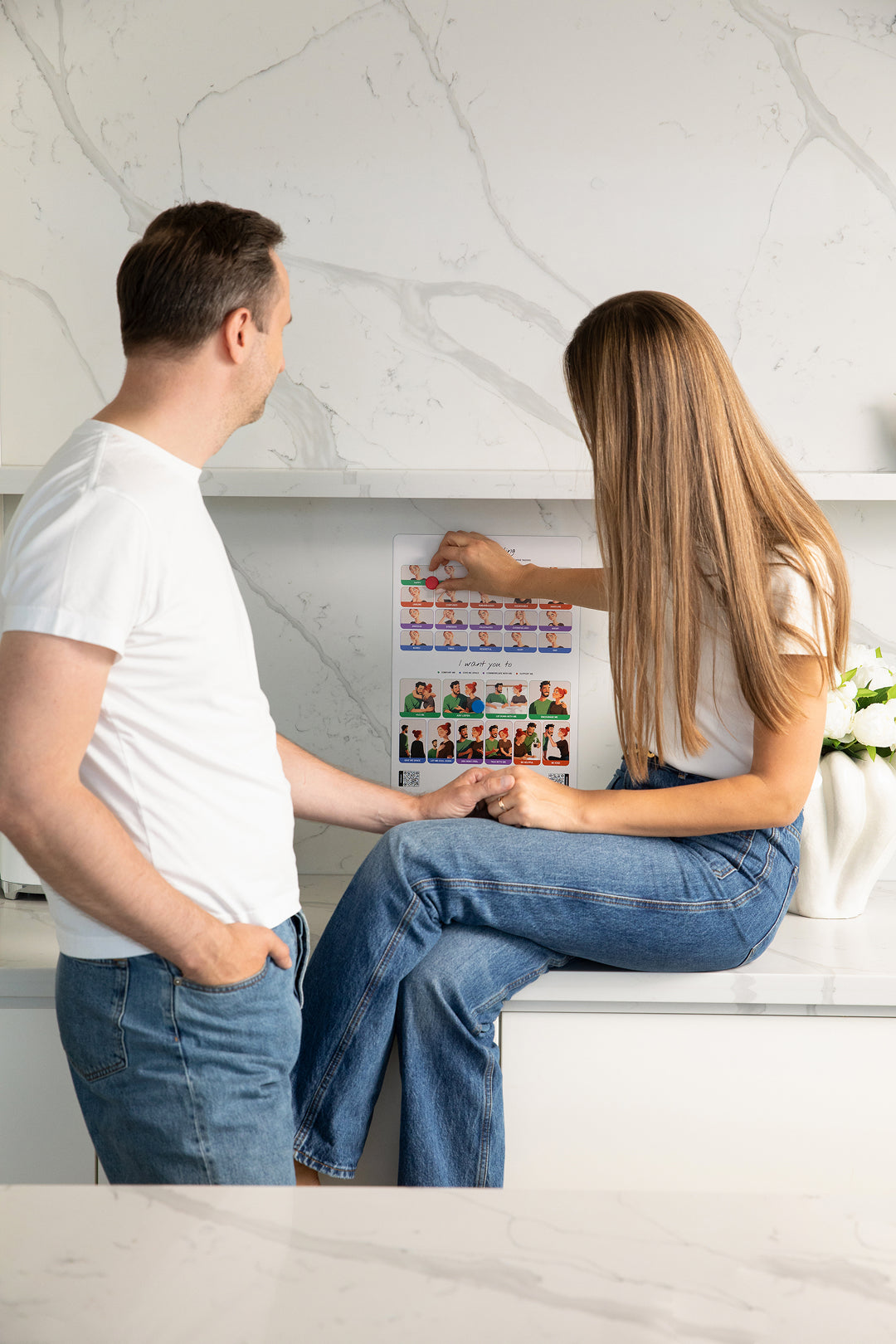
The Twomatoes Emotion Board gives couples a simple way to feel more understood. One partner marks how they feel and what kind of response would help, making it easier for the other to respond with clarity and care. Designed to stay close for everyday moments, the board can be attached, moved, and used whenever words feel difficult.

How it works
A simple way to communicate emotions better every day
1
Place the board
Attach the Emotion Board to your fridge, window, mirror, or any other smooth surface so it naturally becomes part of your everyday routine.
2
Choose your emotion and action
Move the red magnetic pin to show how you're feeling and the blue pin to indicate what you'd like your partner to do at that moment.
3
Help your partner understand you
Give your partner a simple way to understand your emotions and respond in the way you need most.
Explore 20 emotions and 10 ways to show what you need
Emotions
Actions
The thinking behind the board
Two ideas that make feelings easier to communicate

Name what you feel
The board's emotion choices were informed by psychologist Robert Plutchik's model of emotions, which explores how emotions relate to one another and vary in intensity.
We adapted those ideas into 20 recognizable emotions and everyday states that feel relevant to relationships.

Ask for what you need
The partner actions were inspired by principles from Nonviolent Communication, particularly the connection between feelings, needs, and clear requests.
Instead of leaving a partner to guess, the board offers a simple way to ask for a hug, a conversation, encouragement, practical help, or some space.
The Emotion Board is an independently created communication tool inspired by established ideas in emotional awareness and communication. It is not affiliated with or endorsed by Robert Plutchik, the Center for Nonviolent Communication, or any related organization, and it is not a substitute for professional therapy.
Reviews
What couples say about the Emotion Board
“It just works in real life”
“I used to say ‘I’m fine’ even when I wasn’t, mostly because I didn’t know how to explain what I was feeling in the moment. The Emotion Board gave me a simple way to show both my emotions and what I needed. It removed a lot of frustration for both of us.”
Emma, 28
“I genuinely thought I was helping, but I kept responding the wrong way. Sometimes she wanted advice, sometimes space, sometimes just a hug. This board removed the guessing. I finally understood what she actually needed from me.”
“I wasn’t expecting much from it, honestly. I thought it would just sit on our fridge and look nice. But I found myself using it almost every day. I say less now, but somehow I feel more understood.”
“My problem wasn't having feelings - I have plenty of those. My problem was explaining them before becoming frustrated. I like that I can simply point at what I feel and what I need without turning it into a big conversation.”
“I've been married for 11 years, and I learned something slightly embarrassing: I often thought I understood my wife when I actually didn't. The board gave me clearer signals and helped me stop making assumptions.”
“My default mode was ‘fix the problem.’ Apparently, that's not always the correct answer. I learned that sometimes she just needed me to listen, sit with her, or give her some space. Sounds simple, but it changed a lot.”
“The biggest thing for me wasn’t communication. It was relief. I stopped feeling like I had to explain everything perfectly for my partner to understand me.”
“We used to have these small situations where I thought I was doing the right thing and somehow making it worse. The Emotion Board helped me understand the difference between what I assumed she needed and what she actually needed.”
“I like that it feels natural and not like relationship homework. It’s just there on the fridge, part of our day. Small thing, but it changed how understood I feel.”
FAQ
Common questions about the Twomatoes Emotion Board
From how it works to what’s included, here are answers to the questions we hear most often.